
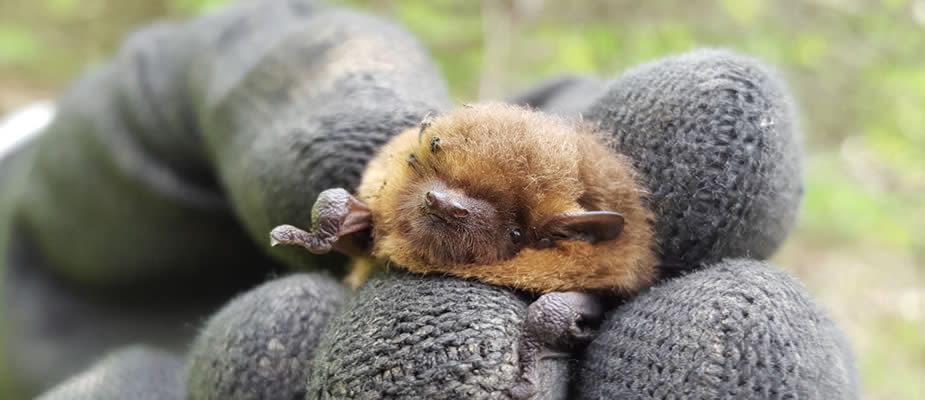
All bats are fully protected under EU Law and as such are a European Protected Species (EPS). This is translated into UK Law under the Wildlife & Countryside Act 1981 (as amended) and the Conservation of Habitats and Species (Amendment) (EU exit) Regulations 2019, which make it an offence to deliberately capture, injure or kills any wild animal of a EPS, deliberately disturb wild animals of any such species or damages or destroys a breeding site (maternity roost) or resting place (day/transitional/hibernation) of such an animal.
Local Planning Authorities, as part of their duty under the National Planning Policy Framework are required regard impacts on biodiversity to validate a planning application. The LPA will request a bat survey (Preliminary Roost Assessment / Bat Risk Assessment) when a planning application will alter the roof or change the environmental conditions within the roof void, such as heating ducts, or the site is present within an area of optimal foraging habitat for bats. The proposed developments that generally require a bat survey include the following:
Residential & Commercial Developments;
Barn conversions;
Loft Extensions;
Building demolition;
Building extensions;
Re-roofing;
Tree limb pruning;
Tree removal;
New road & rail layouts; and
Gas & Water Pipeline Installations.

A Daytime Walkover Survey, previously known as Preliminary Roost Assessment or Bat Risk Assessment, will involve an internal and external inspection of the structures that have the potential to be impacted, both directly and indirectly by the proposed development. In many cases the presence of bats can be concealed within the roof or cavity wall. Further dusk emergence surveys may be needed to fully assess the presence or likely absence of bat roosts within a structure. Costs for dusk emergence surveys are site specific and provided separately after completion of the Daytime Walkover Survey. Our bat surveys and reports follow the Bat Conservation Trust (2023) Bat Surveys for Professional Ecologists: Good Practice Guidelines, 4th Ed.
A survey licence is generally required to undertake a bat survey as disturbance may be a possibility. At FALCO Ecology our staff hold appropriate licenses to complete bat surveys for proposed developments and as part of construction works. We undertake the following bat surveys:
Preliminary Roost Assessment (Bat Risk Assessment) – including loft spaces;
Preliminary Ground Level Roost Assessments;
Hibernation Surveys;
Activity (transect) Surveys; and
Roost (Emergence and Return) Surveys.
We use a high definition thermal camera and an infrared camera to assist with finding potential roosts during bat surveys, saving both time and money. Our thermal camera meets the specifications set out in the new Thermal Imaging Bat Survey Guidelines (2019). Adrian is a competent camera operator and thermal imaging analyser.
“Falco Ecology were excellent from start to finish, from the initial phone call, where they clearly explained what needed to be done, to the full and comprehensive report that was provided in a matter of days. They were also great value for money compared to other quotes I received. I cannot recommend them enough.” James Quigley – Residential Customer.
We undertake bat surveys (Preliminary Roost Assessment / Bat Risk Assessment) nationally and throughout the local area including Newcastle, Gosforth, North Shields, South Shields, Sunderland, Gateshead, Durham, Darlington, Hartlepool, Consett, Blanchland, Corbridge, Hexham, Ponteland, Cramlington, Morpeth, Ashington, Blyth, Alnwick, Rothbury, Haydon Bridge, Haltwhistle, Carlisle, Stanhope, Alston, Darlington, Bishop Auckland, Northallerton, Yarm, Thirsk, Middlesborough, South Tyneside, County Durham, Northumberland, Teeside, North Yorkshire and Cumbria.